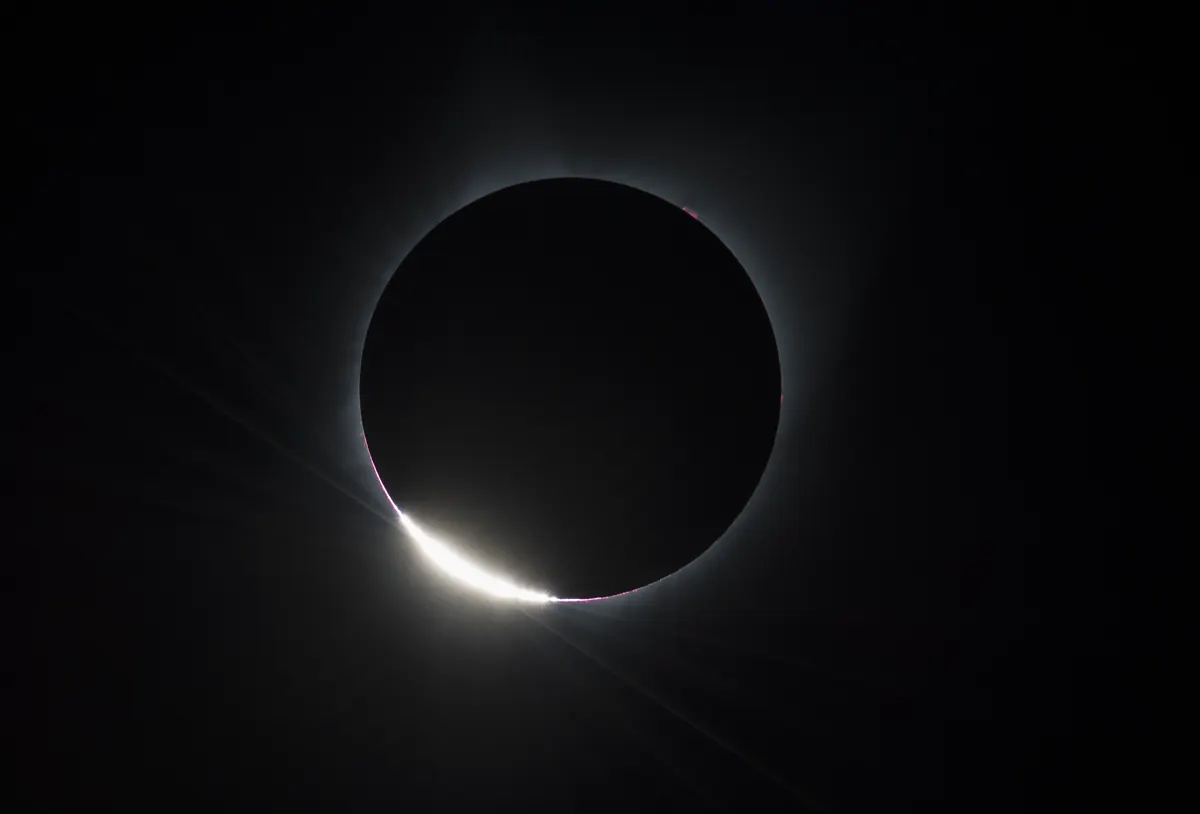
The ten longest total eclipses
| Rank | Date | Longest totality | Path width | Status |
|---|---|---|---|---|
| 1 | July 22, 2009 | 6m 39s | 258 km | Already happened |
| 2 | August 2, 2027 | 6m 23s | 258 km | Still to come |
| 3 | August 12, 2045 | 6m 06s | 256 km | Still to come |
| 4 | May 22, 2096 | 6m 06s | 241 km | Still to come |
| 5 | August 24, 2063 | 5m 49s | 252 km | Still to come |
| 6 | May 11, 2078 | 5m 40s | 232 km | Still to come |
| 7 | September 3, 2081 | 5m 33s | 247 km | Still to come |
| 8 | July 11, 2010 | 5m 20s | 259 km | Already happened |
| 9 | September 14, 2099 | 5m 18s | 241 km | Still to come |
| 10 | April 30, 2060 | 5m 15s | 222 km | Still to come |
The ten longest annular eclipses
| Rank | Date | Longest annularity | Path width | Status |
|---|---|---|---|---|
| 1 | January 15, 2010 | 11m 08s | 333 km | Already happened |
| 2 | January 26, 2028 | 10m 27s | 323 km | Still to come |
| 3 | February 5, 2046 | 9m 42s | 310 km | Still to come |
| 4 | February 17, 2064 | 8m 56s | 295 km | Still to come |
| 5 | November 15, 2096 | 8m 53s | 294 km | Still to come |
| 6 | November 27, 2095 | 8m 47s | 285 km | Still to come |
| 7 | November 4, 2078 | 8m 29s | 287 km | Still to come |
| 8 | February 27, 2082 | 8m 12s | 277 km | Still to come |
| 9 | October 24, 2060 | 8m 06s | 281 km | Still to come |
| 10 | January 26, 2009 | 7m 54s | 280 km | Already happened |
Why some are so much longer
An eclipse lasts longest when the Moon is near its closest point to Earth, which makes it look as large as it can, and when the Sun is high and the path is near the equator, where Earth's surface moves fastest in the same direction as the shadow. The theoretical limit for totality is about seven and a half minutes, which this century doesn't reach: its best is 6m 39s.
One family of eclipses owns the record book
Look down the table above and a pattern jumps out. Six of the ten longest total eclipses of the century aren't separate events at all. They belong to one family, Saros series 136, whose eclipses come back every 18 years, 11 days and about eight hours. NASA's catalog counts 71 eclipses in the series, from a small partial eclipse in 1360 to another in 2622, a run of about 1,262 years.
The series peaked in the middle of the twentieth century. The eclipse of June 20, 1955 lasted 7 minutes 8 seconds at its longest, and the 1973 and 1991 eclipses were only a little shorter. Every member since has been shorter than the one before. The century's best, on July 22, 2009, was already on the way down at 6 minutes 39 seconds, and the next one in the family, on August 2, 2027, will manage 6 minutes 23 seconds.
| Date | Longest totality | Path width |
|---|---|---|
| May 29, 1919 | 6m 51s | 244 km |
| June 8, 1937 | 7m 04s | 250 km |
| June 20, 1955 | 7m 08s | 254 km |
| June 30, 1973 | 7m 04s | 256 km |
| July 11, 1991 | 6m 53s | 258 km |
| July 22, 2009 | 6m 39s | 258 km |
| August 2, 2027 | 6m 23s | 258 km |
| August 12, 2045 | 6m 06s | 256 km |
| August 24, 2063 | 5m 49s | 252 km |
| September 3, 2081 | 5m 33s | 247 km |
| September 14, 2099 | 5m 18s | 241 km |
Durations before 2001 are from NASA's catalog page for Saros 136. Later ones are from the catalog used on the rest of this page.
The jet that chased the Moon's shadow
The eclipse of June 30, 1973 was a member of that family, with 7 minutes 4 seconds of totality on the ground. A team of 7 French, British and American observers decided that wasn't enough. The prototype Concorde 001 took off from Las Palmas, Canary Islands, flew east to meet the Moon's shadow and kept pace with it, so the observers watched a total eclipse for about 74 minutes, roughly ten times what anyone on the ground saw. The aircraft landed at Fort-Lamy (now N'Djamena), Chad, and the results appeared in the journal Nature that year.
The trick works because the shadow only crosses Earth quickly, not instantly. Near the equator it sweeps along at about 1,923 kilometers an hour, taking the Moon's average speed from NASA's fact sheet and subtracting the speed of the ground beneath it, and only a very fast aircraft can keep up. The 74 minutes is usually cited as the longest anyone has watched a total solar eclipse.
Why the long ones come in summer
Three things stretch totality. The first is a Moon near its closest point to Earth, which makes it look big enough to cover the Sun with room to spare. NASA's fact sheet gives the Moon's distance as about 363 thousand kilometers at its nearest and 406 thousand at its farthest, so its apparent size changes by about 12 percent over a month.
The second is a Sun that looks as small as possible, which happens in early July, when Earth is farthest from it. Earth is 152.1 million kilometers away at its farthest and 147.1 million at its nearest, so the Sun looks about 3 percent smaller in July than in January. That's why every one of the long Saros 136 eclipses from 1955 to 2063 falls between June and August.
The third is where the shadow lands. Earth's surface moves eastward at about 1,677 kilometers an hour at the equator, in the same direction as the shadow, so near the equator the shadow takes longer to slide past you. The longest eclipses cross the tropics, and the point of greatest eclipse on August 2, 2027 sits at 26N 33E.
Why 7 minutes 31 seconds is a ceiling
If all three factors lined up perfectly, totality could last about 7 minutes 31 seconds. That figure goes back to a calculation published in 1929 and is still quoted as the theoretical maximum. No eclipse this century reaches it, because the Sun, Moon and Earth rarely sit in their best positions at once. The best of 2001 to 2100 is 6 minutes 39 seconds, and the tenth best is 5 minutes 15 seconds.
Most total eclipses are far shorter, and the time you get at your own spot is shorter than the longest moment anywhere on the path. That's a good reason to travel to the center line instead of watching from the edge.
Rings can last longer than totality
An annular eclipse can beat any total one for time. NASA's catalog lists the annular eclipse of January 15, 2010 at 11 minutes 8 seconds, with a path 333 kilometers wide, and says a longer one won't come around until December 23, 3043. The Moon was close to its farthest point from Earth, so it looked small, and the ring of sunlight around it lasted a long time. The longest still to come in this list is on January 26, 2028, at 10 minutes 27 seconds, crossing Ecuador, Peru, Brazil, Colombia, Suriname, French Guiana, Portugal, Spain and Morocco. The annular eclipse page lists them all.
What a long eclipse is worth
A long totality is a gift to anyone who wants to photograph the Sun's outer atmosphere, which can only be seen from the ground while the bright disk is covered. The next total eclipse in the top ten is on August 2, 2027, with up to 6 minutes 23 seconds of totality on a path 258 kilometers wide, crossing Morocco, Spain, Algeria, Tunisia, Libya, Egypt, Sudan, Saudi Arabia, Yemen and Somalia. The next solar eclipse page has the times.
The safety rule doesn't change with the length of the eclipse. NASA says you can look at the Sun without eye protection only during the brief total phase, when the Moon completely covers its bright face. At every other moment you need eclipse glasses that meet the ISO 12312-2 standard, and ordinary sunglasses aren't safe. Details are on NASA's eclipse safety page (opens in a new tab).
 Total solar eclipsesEvery total eclipse through 2050.
 Annular solar eclipsesEvery ring of fire eclipse through 2050.
 Next solar eclipseThe next eclipse of any kind.
Questions people ask
What's the longest solar eclipse this century?
The longest total solar eclipse between 2001 and 2100 lasts 6m 39s, on July 22, 2009.
What's the longest annular eclipse this century?
11m 08s, on January 15, 2010.
When is the next long total eclipse?
The next one in the top ten is on August 2, 2027, with 6m 23s of totality.
Why do some eclipses last longer?
The Moon is closer to Earth and looks bigger, and the path is near the equator where the ground moves fastest with the shadow.