Every total and hybrid solar eclipse
| Date | Type | Greatest eclipse | Magnitude | Longest totality or annularity | Path width | Where the path crosses |
|---|---|---|---|---|---|---|
| August 2, 2027 | Total | 10:06 UTC | 1.079 | 6m 23s | 258 km | Morocco, Spain, Algeria, Tunisia, Libya, Egypt, Sudan, Saudi Arabia, Yemen and Somalia |
| July 22, 2028 | Total | 02:55 UTC | 1.056 | 5m 10s | 230 km | Australia and New Zealand |
| November 25, 2030 | Total | 06:50 UTC | 1.047 | 3m 44s | 169 km | Namibia, Botswana, South Africa, Lesotho and Australia |
| November 14, 2031 | Hybrid | 21:06 UTC | 1.011 | 1m 08s | 38 km | Panama |
| March 30, 2033 | Total | 18:01 UTC | 1.046 | 2m 37s | 781 km | Russia and United States |
| March 20, 2034 | Total | 10:17 UTC | 1.046 | 4m 09s | 159 km | Benin, Nigeria, Cameroon, Chad, Sudan, Egypt, Saudi Arabia, Kuwait, Iran, Afghanistan, Pakistan, India and China |
| September 2, 2035 | Total | 01:55 UTC | 1.032 | 2m 54s | 116 km | China, North Korea, South Korea and Japan |
| July 13, 2037 | Total | 02:39 UTC | 1.041 | 3m 58s | 201 km | Australia and New Zealand |
| December 26, 2038 | Total | 00:58 UTC | 1.027 | 2m 18s | 95 km | Australia and New Zealand |
| December 15, 2039 | Total | 16:22 UTC | 1.036 | 1m 51s | 380 km | Antarctica |
| April 30, 2041 | Total | 11:50 UTC | 1.019 | 1m 51s | 72 km | Angola, Democratic Republic of the Congo, Uganda, Kenya and Somalia |
| April 20, 2042 | Total | 02:16 UTC | 1.061 | 4m 51s | 210 km | Indonesia, Malaysia, Brunei and Philippines |
| April 9, 2043 | Total | 18:56 UTC | 1.010 | n/a | n/a | See NASA's path table |
| August 23, 2044 | Total | 01:15 UTC | 1.036 | 2m 04s | 453 km | Greenland, Canada and United States |
| August 12, 2045 | Total | 17:41 UTC | 1.077 | 6m 06s | 256 km | United States, Bahamas, Haiti, Dominican Republic, Venezuela, Trinidad and Tobago, Guyana, Suriname, French Guiana and Brazil |
| August 2, 2046 | Total | 10:19 UTC | 1.053 | 4m 51s | 206 km | Brazil, Angola, Namibia, Botswana, South Africa, Eswatini, Mozambique and French Southern and Antarctic Lands |
| December 5, 2048 | Total | 15:33 UTC | 1.044 | 3m 28s | 160 km | Chile, Argentina, Namibia and Botswana |
| November 25, 2049 | Hybrid | 05:32 UTC | 1.006 | 0m 38s | 21 km | Saudi Arabia, Yemen and Indonesia |
| May 20, 2050 | Hybrid | 20:41 UTC | 1.004 | 0m 21s | 27 km | open ocean or ice, with no country on the path |
16 are total and 3 hybrid. A hybrid eclipse is total along part of its path and annular along the rest, so the Sun is fully covered only in some places.
Where totality happens most
Counting the countries on each path, these are the ones that see the most total or hybrid eclipses before 2050. A country counts once per eclipse, however long the path inside it.
What totality is like
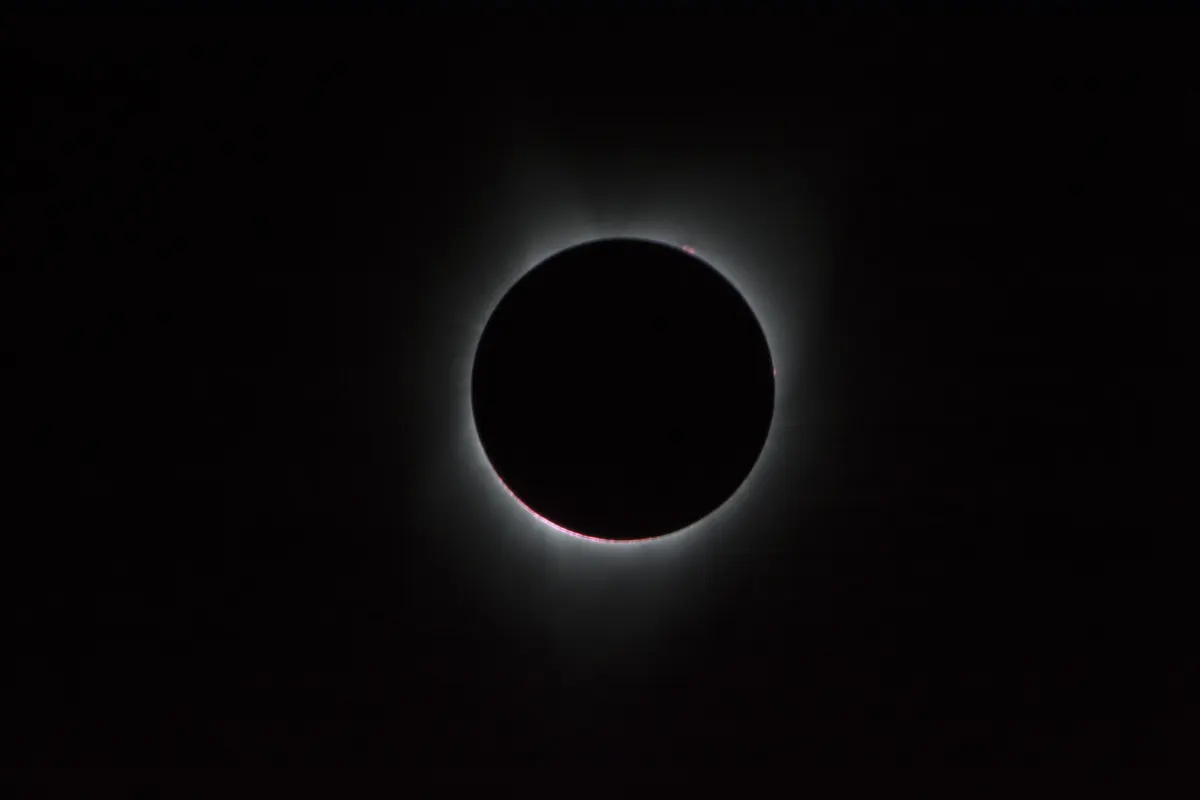
During totality the Moon covers the Sun completely and the sky goes dark enough to see bright stars and planets. The Sun's faint outer atmosphere, the corona, shows around the black disc. It lasts from seconds up to a few minutes, and the path of totality is only tens to a couple of hundred kilometers wide, so the place you watch from matters far more than the date.
When a total eclipse crossed America twice
For many people alive today, the idea of a total eclipse changed in 2017. The eclipse of August 21, 2017 was the first total eclipse to cross the United States from coast to coast since June 8, 1918, and totality lasted up to 2 minutes 40 seconds. On April 8, 2024 a second one swept from Mexico across the United States and Canada, along a path about 183 kilometers wide. Totality at its longest lasted 4 minutes 28 seconds.
Eclipses have changed science, too. Einstein's general relativity predicted that starlight passing the Sun's edge would shift by 1.75 arcseconds, twice the 0.875 that Newton's gravity gave. Teams at Principe and at Sobral in Brazil photographed stars around the totally eclipsed Sun on May 29, 1919 and reported results that favored Einstein. That eclipse belongs to Saros 136, the same family as the long eclipses of 1955 and 1973 covered on the longest eclipses page.
Inside totality
NASA says the partial phase before totality is long, about 70 to 80 minutes at most locations for the 2024 eclipse, and you need eclipse glasses throughout. Then, as the last of the Sun slips away, the air temperature drops and an eerie silence often settles. Fast, faint, dark bands called shadow bands can ripple across plain surfaces just before and after.
The final sunlight shines through valleys on the Moon's edge as a string of bright points called Baily's beads, then shrinks to one point that looks like the diamond on a ring around the dark disk. When that goes, the corona appears as streams of white light, a thin pink circle of chromosphere rings the Moon, and brighter stars or planets may show in a sky as dark as dawn or dusk. You may see a sunset all the way round the horizon.
The safety instructions matter most here. NASA says to keep your glasses on until the Moon has completely covered the Sun, to take them off only for totality, and to put them back on before totality ends. Never use eclipse glasses with a camera, binoculars or a telescope: any optics need a solar filter on the front.
A coincidence with an expiry date
Total eclipses exist because of an odd bit of luck. The Sun is about 400 times wider than the Moon and about 400 times farther away, so the two look about the same size in our sky. The match isn't exact. The Moon's distance changes by about 12 percent and Earth's distance from the Sun by about 3 percent, which is why some eclipses are total and others leave a ring, as the annular eclipse page explains.
The Moon is also moving away from Earth by about 3.8 centimeters a year, roughly the speed fingernails grow. In time it'll look too small to cover the Sun at all. Sky & Telescope puts that more than 600 million years away, so there's no hurry.
Waiting for your turn
A given place on Earth sees a total eclipse only about once every 375 years on average, a figure given on NASA's eclipse pages and in the work of the eclipse expert Jean Meeus. That's a global average. It hides big differences, and it's better treated as a reason to travel than as a prediction for your town.
The next one in this list is on August 2, 2027, with up to 6 minutes 23 seconds of totality over Morocco, Spain, Algeria, Tunisia, Libya, Egypt, Sudan, Saudi Arabia, Yemen and Somalia. That's 2.4 times the totality of the 2017 eclipse. The next time totality touches the United States is March 30, 2033, with 2 minutes 37 seconds at the longest point.
The place matters more than the date
The path of totality is only 21 to 781 kilometers wide in this list, on a planet about 12,756 kilometers across. Step off the path and you see a partial eclipse, which never gets dark. The time you get also falls toward zero at the edges of the path, so the center line is worth the effort.
Weather is the other gamble. Cloud on the day will beat any plan, so look up the typical cloud cover for the place and season, keep a second site within driving distance, and leave time to move. The next solar eclipse page has the times for the coming one.
 Next solar eclipseThe next eclipse of any kind, with times.
 Longest solar eclipsesThe longest totalities of the century.
 Annular solar eclipsesThe ring of fire eclipses.
Questions people ask
How many total solar eclipses are there before 2050?
16 total and 3 hybrid solar eclipses fall between October 19, 2026 and the end of 2050.
When is the next total solar eclipse?
August 2, 2027, with up to 6m 23s of totality.
Which country sees the most total eclipses before 2050?
Australia is on the path of 4 of them.
How long does totality last?
In this period the longest is 6m 23s, on August 2, 2027. Most are shorter, and totality at any one spot is shorter than the maximum on the path.
Between eclipses, Parker Solar Probe samples the corona from inside it.