Rings or no rings
| World | Rings? | Kind |
|---|---|---|
| Mercury | No | Rocky planet |
| Venus | No | Rocky planet |
| Earth | No | Rocky planet |
| Mars | No | Rocky planet |
| Jupiter | Yes | Gas giant |
| Saturn | Yes | Gas giant |
| Uranus | Yes | Ice giant |
| Neptune | Yes | Ice giant |
| Pluto | No | Dwarf planet |
From the NASA Planetary Fact Sheet.
Saturn: ears, handles and a gap
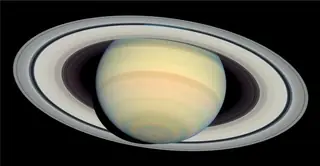
Rings were first noticed in 1610, when Galileo pointed an early telescope at Saturn and saw what he took to be two companion bodies on either side of the planet. They didn't look like a ring, and he never worked it out. In 1655 Christiaan Huygens, with a better telescope, saw a thin flat ring around the planet, and he published the idea in 1659. In 1675 Giovanni Domenico Cassini saw that the ring was split by a dark gap, which now carries his name. Later still, James Clerk Maxwell showed in the late 1850s that a solid ring couldn't be stable, and James Keeler proved with a spectrograph in 1895 that the ring is made of separate particles.
What they are made of
Saturn's rings are billions of chunks of ice and rock, coated with dust, from grains as small as dust to pieces as big as a house, and a few as big as mountains. The system stretches up to about 282,000 kilometers from the planet, yet the main rings are typically only about 10 meters thick. The width is about 28,200,000 times the thickness. A gap 4,700 kilometers wide, the Cassini Division, separates the two brightest rings, A and B. When the rings tilt edge-on to Earth, as they did in 2025, they almost vanish from view.
How old are they?
Nobody agrees. NASA's Cassini spacecraft measured the mass of the rings, and the answer was low: only about 0.4 times the mass of Saturn's moon Mimas. Because the rings are so clean and bright, some researchers argue they're only 10 to 100 million years old, young compared with Saturn itself. Other researchers say that rings could stay bright for far longer. They may be pieces of comets, asteroids or shattered moons torn apart by Saturn's gravity.
Jupiter: dark and faint
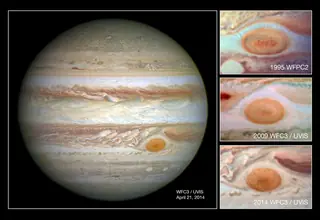
Jupiter's rings were a surprise. NASA's Voyager 1 spacecraft found them on March 4, 1979, as it approached the planet. They're made of small, dark particles and are hard to see except when backlit by the Sun. Data from the Galileo spacecraft suggest the dust is kicked up when interplanetary meteoroids smash into the planet's small inner moons.
Uranus: found by a star winking out
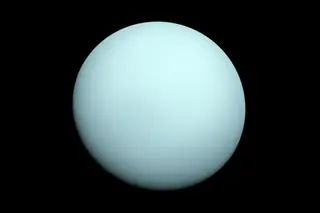
Uranus has 13 faint rings in two sets, by NASA's count. The inner system has nine mostly narrow, dark gray rings, and two outer rings differ in color: the inner one is reddish and the outer one is blue, like Saturn's E ring. They were found by accident on March 10, 1977, when astronomers aboard NASA's Kuiper Airborne Observatory watched Uranus pass in front of a star and saw the starlight blink out several times before and after the planet itself blocked it. That was the first sign of narrow rings.
Neptune: arcs
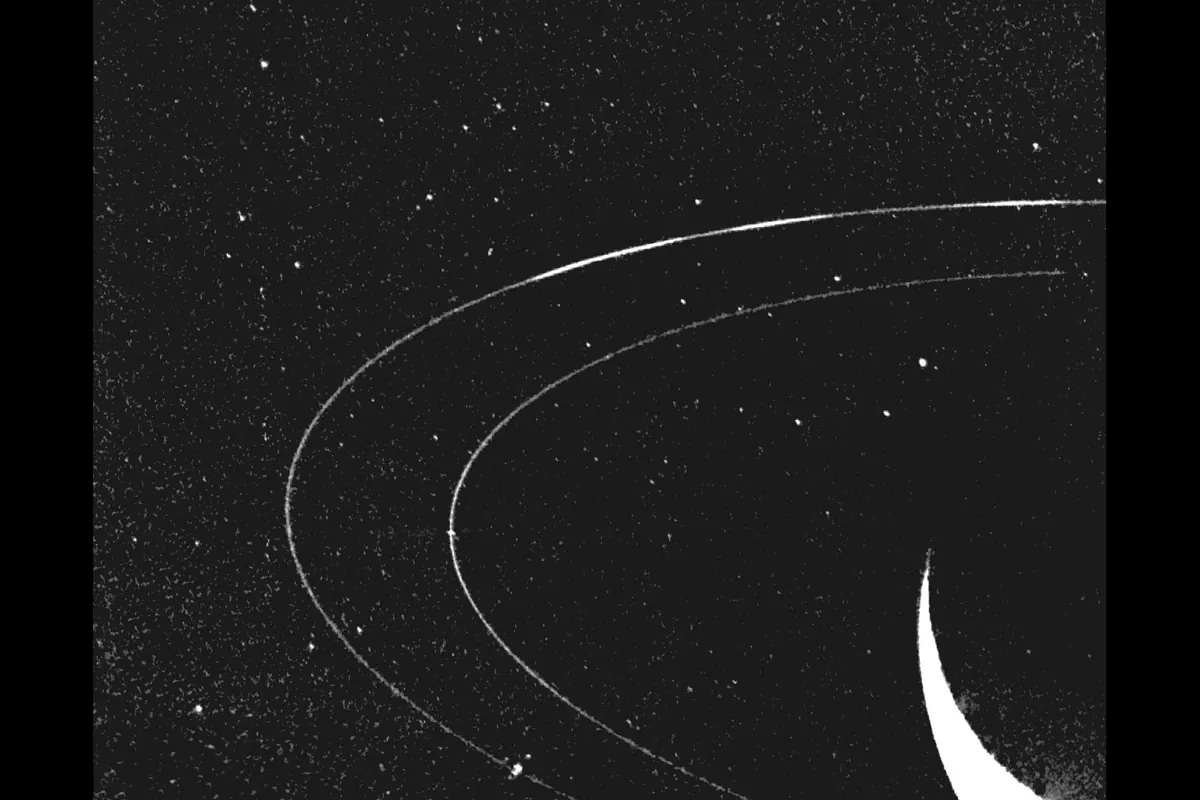
Neptune's rings, studied by Voyager 2 in August 1989, include an outermost ring where material mysteriously clumps into three arcs, as in the image above. Nobody had expected the clumps, since rings of loose material should spread into an even band.
Rings elsewhere
The four giants aren't the only ringed worlds. In 2013 astronomers found two narrow rings around Chariklo, a small body between Saturn and Uranus. Later discoveries include a ring around the dwarf planet Haumea in 2017 and one around Quaoar in 2023. Rings turn out to be less rare than the textbooks used to say.
The rocky planets
Mercury, Venus, Earth and Mars have no rings. Mars's moon Phobos is slowly moving toward the planet and will crash into it or break apart in about 50 million years, so Mars might have a ring one day. A small telescope shows Saturn's rings clearly, and the Saturn opposition page says when the planet is best placed. The moons page counts the moons that orbit alongside these rings.
Why rings sit close to the planet
A ring system can only survive inside a certain distance from its planet. Beyond it, the particles would clump together into a moon. Inside it, the planet's tides pull any clump back apart. That's why rings hug the planet, and why they're thought to form when a moon or a comet strays too close and is torn up. Saturn's rings are broad, and they stay inside that zone.
Watching rings change
Rings aren't static. NASA's Cassini measured ring material falling into Saturn, and that rain is one reason researchers think the rings may not last forever. That also matters for the age argument. Saturn's tilt of 26.7 degrees turns the rings edge-on to Earth twice in each orbit of 29.4 years, and they nearly vanish for a few weeks, as they did in 2025. The tilt and seasons page shows why.
The moons that shape the rings
Small moons sit in and around Saturn's rings and keep them tidy. Pan and Daphnis clear narrow gaps as they orbit. Saturn's moon Enceladus feeds a different ring: NASA says its geysers supply the material of the E ring. Rings and moons are two parts of one system, which is why the moon counts on the moons page and the ring list here belong together.
Why rings are hard to see
Only Saturn's rings show up in a small telescope. Jupiter's are dark and faint, Uranus's are thin and narrow, and Neptune's arcs are clumps in a very thin ring, so those three were found by spacecraft or by clever timing and not by looking. A modest telescope on a clear night does the job for Saturn, and the rings are the draw.
Questions people ask
Which planets have rings?
Jupiter, Saturn, Uranus and Neptune. All four are giant planets.
Which planet has the biggest rings?
Saturn. None of the others has rings as spectacular or as complex.
What are Saturn's rings made of?
Billions of small chunks of ice and rock coated with dust, from dust-sized grains to pieces as big as a house.
Does Earth have rings?
No. Earth, Mars, Venus and Mercury have none.